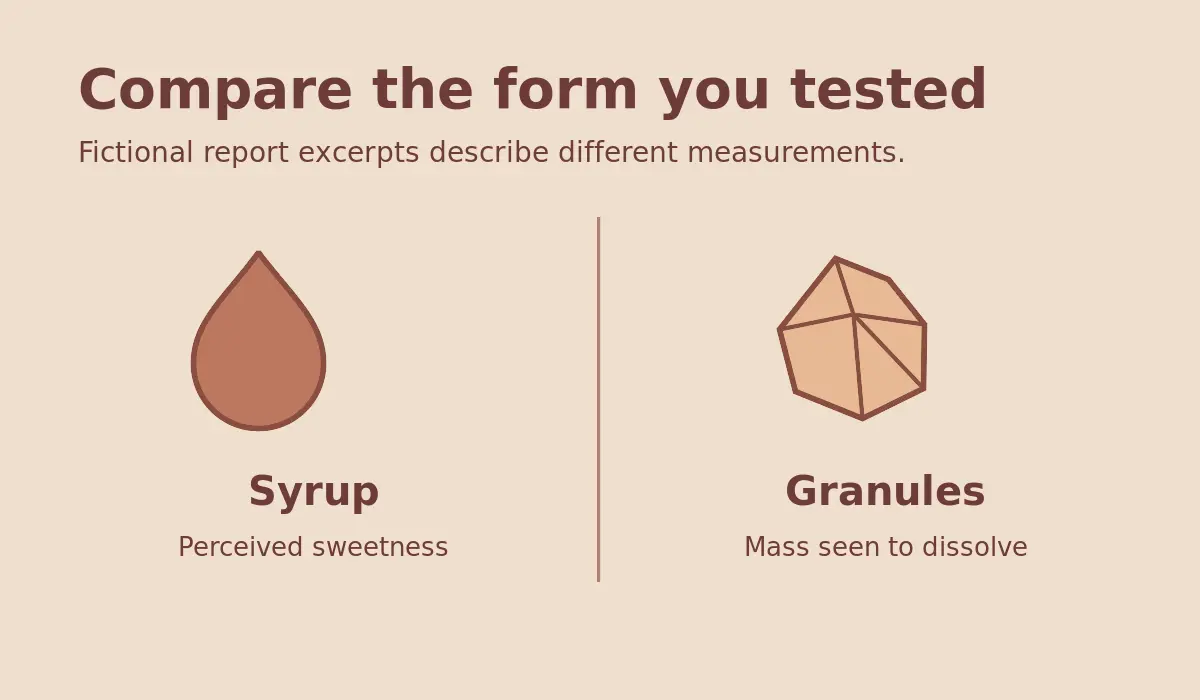
One prototype sheet says a syrup matched a sugar reference for perceived sweetness. A second says 9 g of a 10 g granule sample dissolved over the recorded interval. Both can be encouraging entries in an ingredient project. To decide whether the syrup and granules perform similarly, the two sheets still need a measurement they share.
In this invented case, the syrup is evaluated in a drink and the granules are observed in water. The syrup result records how a sample tasted in one finished mixture. The granule result records an amount that dissolved under particular conditions. The notes could help a team choose what to read next. A fast-dissolving sample does not acquire a sweetness score by virtue of dissolving.
Read the condition into the measurement
The first sheet needs the kind of drink, the sugar reference and the basis on which the samples were compared. The second needs the liquid and the stated time, along with enough context to interpret the starting and remaining material. If two different granule samples go into liquids at different temperatures, even two values labelled “grams dissolved” can hide a changed condition.
Douxmatok’s European patent application, published in 2018, gives a useful historical example of why the form appears in the comparison. Some examples describe tasting a liquid sweetener composition against a sucrose solution, and another describes tasting equal masses of dried material and sucrose. The filing describes how its own samples were compared. The examples concern a separate project and furnish no result for SLADCORE. European patent application EP3340802A1, Examples 9 and 18.
Keep the feasibility report’s claim in view
SLADCORE’s own period report records early samples and further work on physicochemical and sensory characteristics. It also describes unresolved questions about the physical properties of material during development. When a short description of an ingredient form turns up in the archive, the phrase “properties tested” is only useful once the measure is named. For the invented sheets, a comparison of perceived sweetness requires both ingredients to appear in comparable samples with the same sensory outcome. A comparison of dissolution calls for a different matched record. SLADCORE period report, work performed in 2018.